Meridian Life Science Academic Site

MyTaq HS Red DNA Polymerase

A new generation of hot-start polymerase that delivers improved specificity, yield, speed and robustness when amplifying targets from any template.

MyTaq HS Red DNA Polymerase

Sensitive – exhibits increased affinity for DNA, thereby improving amplification of even limiting amounts of template

Efficient – novel buffer system maximizes efficiency of PCR amplification, delivering improved yield of any PCR product

Specific – an antibody-mediated hot-start enzyme that remains completely inactive during PCR set-up to prevent non-specific amplification

Flexible – ideal for amplifying any target up to 5 kb, including DNA extracted from human, animal and plant samples

Fast – developed to give sensitive, reproducible and robust amplification of a broader range of targets under fast thermal cycling conditions

Convenient – includes all the components necessary for high performance PCR amplification

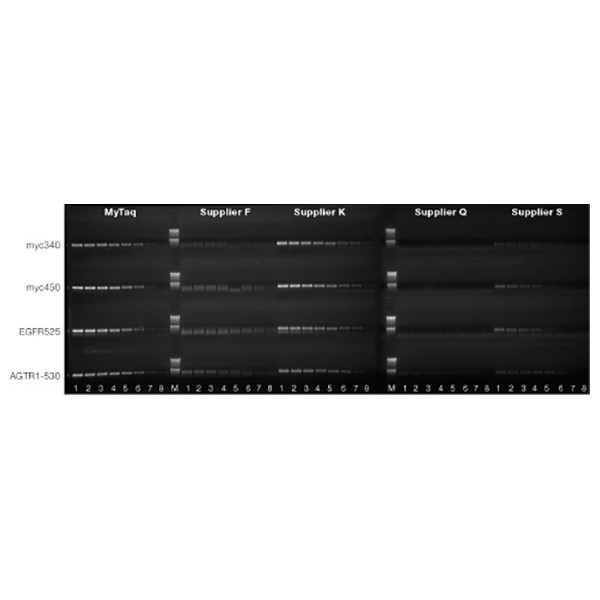
A 340 bp (A) and a 450 bp (B) fragment of the myc gene, a 525 bp (C) fragment of the EGFR gene and a 530 bp (D) fragment of the AGRI1 gene were amplified using MyTaq™ HS and hot-start DNA polymerases from Suppliers F, K, G and S. Each polymerase was used to set-up PCR reactions containing either 100 ng, 33 ng, 10 ng, 4 ng, 1 ng, 33 pg, 10 pg and 3 pg of human genomic DNA (Lanes 1-8 respectively), prepared by a 3-fold serial dilution. Marker is HyperLadder 1kb (M). MyTaq™ HS performed well across all four human genes.

M13 vector carrying a DNA insert was cloned into E.coli cells. 2 µL increments of agar (2a) and 2 µL increments of LB (2b) were added to a series of 50 µL PCR reactions (Lanes 1-8 respectively). The results show that MyTaq™ HS DNA Polymerase was more resistant to inhibition than that of supplier S. Individual colonies were picked from a plate of E.coli, washed directly into MyTaq™ buffer and amplified using MyTaq™ HS and primers for either a 2.6 kb or an 884 bp amplicon. Marker is HyperLadder 1kb (M). The results illustrate MyTaq™ DNA Polymerase is robust and gives highly–specific results.

Product Description

MyTaq™ HS Red DNA Polymerase is a new generation of antibody-mediated hot-start enzyme, engineered for highly specific and efficient amplification from even the most challenging templates. MyTaq™ HS remains inactive at room temperature allowing for convenient reaction set-up, thereby reducing non-specific amplification that can hinder PCR assays from the start. These properties make MyTaq™ HS Red DNA Polymerase the ideal choice for PCR assays containing complex and low copy number targets.

The inclusion of dNTPs, MgCland enhancers at optimal concentrations in the buffer helps eliminate the need for optimization, thereby saving time, effort and the cost of performing unnecessary assay repeats. The optimized buffer system and MyTaq™ HS with its increased affinity for DNA, enables very high yield PCR amplification over a wide range of PCR templates, resulting in reliable amplification from even very low amounts of template.

The advanced formulation of MyTaq™ HS Red DNA Polymerase and buffer system has been developed to give more robust amplification than other commonly-used polymerases, meaning it performs reliably even in the presence of PCR inhibitors. Furthermore it allows fast cycling conditions, considerably reducing the reaction time without compromising PCR specificity or yield.

MyTaq™ HS Red DNA Polymerase includes a 5x MyTaq™ Red Reaction Buffer that increases the visual contrast between the reagent and the reaction vessel for improved convenience and to improve pipetting accuracy. The red dye also enables samples to be loaded directly on to a gel after the PCR eliminating the need to add loading buffer.

Applications

  • Fast PCR
  • Multiplex PCR
  • Genotyping
  • Specific amplification of challenging (e.g. GC-rich) templates
  • Multiplex PCR
  • Low copy number PCR assays
  • High-throughput assays with prolonged PCR set-up


Product Specification

Presentation BIO-21115 1,000 Units (Polymerase 200 µL, Buffer 8x 1.5 mL)
BIO-21116 2,500 Units (Polymerase 2x 250 µL, Buffer 14x 1.5 mL)
Appearance Clear, colorless polymerase, red buffer solution
Hot start Antibody mediated
Application Fast PCR, Multiplex PCR, Genotyping, Complex templates (e.g. GC-rich), Low copy number PCR assays, High-throughput assays with prolonged PCR set-up
Sample type DNA, cDNA
Presentation 3 vials / 9 vials / 16 vials
Storage -20 °C
Mix stability See outer label
Specific Activity 5 u/µL
Functional Single band of PCR product on an agarose gel and sensitivity
DNA Contamination No detectable product in a qPCR assay
DNase Contamination No detectable degradation

Product Ordering

Cat. No.              Size

BIO-21115          1000 Units

BIO-21116         2500 Units

Product Support Material

View all Documents

I like this product because it is easy to use and fast to set up a PCR reaction. Very conv...

Kristina Marinak, West Virginia University, Morgantown, US

The MyTaq HS sample was so much better than anything else we have used, we have ordered mo...

Roslin Institute, Scotland

FAQs:

MyTaq HS Red DNA Polymerase

What would be the recommended DNA polymerase for difficult samples like GC rich or bisulfite converted DNA?
The MyTaq HS DNA polymerase works very well with difficult samples like GC rich or bisulfite converted DNA. Especially the hot-start is important, as it decreases primer dimer and unspecific amplification. We would suggest to start with the recommended protocol. If optimization is needed, we would suggest to optimize the annealing temperature. Due to the degraded DNA after bisulfite conversion it may be useful to increase the amount of template and polymerase.
My DNA sample contains PCR inhibitors, which impairs my PCR results. What can I do for optimization?
If possible, we would recommend an additional cleanup of affected samples, for instance, customers had very good experiences with the clean-up of samples containing humic acids with SureClean Plus. Alternatively decreasing the template concentration will help to minimize the amount of inhibitors, the amount of polymerase and primer can be increased, but do not exceed the suggested limits.
Which polymerase do I need for my specific application?
At Meridian we pride ourselves in supplying high-quality polymerases to suit your requirements. To aid your selection of the most suited enzyme for your specific applications, please see our enzyme selection tool.
What are the storage conditions and stabilities of Meridian polymerases?
All our polymerases are guaranteed for a period of 12 months from the date of purchase. These should be stored at -20°C during this time for optimal retention of activity. Please Note: We do not recommend the storage of our polymerases at -80 °C as ice crystals could form on the active site, which may affect or destroy the activity of the enzyme.
I am having problems optimizing my PCR, what would you recommend?
PCR can be a challenging technique, with various parameters to optimize to achieve the best results. If you are having problems, these could be easily resolved by addressing a few issues. Please see our PCR troubleshooting guide for suggestions and help with your specific problems. Observation Recommended Solution(s) No or low PCR yield Enzyme concentration too low – increase the amount of enzyme in 0.5 U increments. Primers degraded – check quality and age of the primers. Magnesium concentration too low – increase concentration in 0.25 mM increments with a starting concentration of 1.75 mM. Primer concentration not optimized. Titrate primer concentration (0.3-1 µM); ensuring that both primers have the same concentration. Template concentration too low – Increase concentration of template. Perform a positive control to ensure that the enzyme, dNTPs and buffers are not degraded and/or contaminated. Multiple Bands Primer annealing temperature too low. Increase annealing temperature. Primer annealing should be at least 5°C below the calculated Tm of primers. Prepare master mixes on ice or use a heat-activated polymerase. For problems with low specificity. Try adding 3% DMSO (not supplied) to improve specificity. Smearing or artifacts Template concentration too high. Prepare serial dilutions of template. Too many cycles. Reduce the cycle number by 3-5 to remove non-specific bands. Enzyme concentration too high - decrease the amount of enzyme in 0.5 U increments. Extension time too long. Reduce extension time in 0.5-1 minute increments.
What do the terms yield, fidelity, processivity and specificity actually mean?
These terms refer to parameters to be considered when performing PCR and are important features in selecting the correct enzyme for your needs. Understanding what they mean is therefore crucial: Yield: The amount of DNA produced in a PCR reaction. Fidelity: The accuracy of the enzyme at incorporating the correct dNTP to the elongating DNA strand. Processivity: The length of time a polymerase is associated with the template and therefore the size of fragment which can be amplified. Specificity: A measure of the unwanted by-products generated in a reaction.
What are the benefits of using a hot-start polymerase?
During PCR setup at room temperature, standard polymerases will have some activity. When using a hot-start polymerase, this enzyme will have no activity at room temperature, thus reducing the risk of unspecific products in the reaction due to these mis-primed oligonucleotides. This feature makes this type of polymerase ideally suited to high-throughput applications, where the reactions may be left sitting at room temperature for prolonged periods of time.
How is one unit of activity of a polymerase defined?
One unit is defined as the amount of enzyme that incorporates 10 nmoles of dNTPs into acid-insoluble form in 30 minutes at 72°C.
What are the advantages of using a 2x mix rather than setting up a PCR reaction from scratch?
All Meridian polymerases are available in the convenient format of a 2x master mix, containing all the reagents and additives necessary to perform successful PCR, with the exception of template, primers and water. This formulation not only provides a convenient and hassle-free PCR setup, but also significantly reduces the chances of human error, inaccuracies and contamination by reducing the pipetting steps required.
What would be the recommended DNA polymerase for difficult samples like GC rich or bisulfite converted DNA?
The MyTaq HS DNA polymerase works very well with difficult samples like GC rich or bisulfite converted DNA. Especially the hot-start is important, as it decreases primer dimer and unspecific amplification. We would suggest to start with the recommended protocol. If optimization is needed, we would suggest to optimize the annealing temperature. Due to the degraded DNA after bisulfite conversion it may be useful to increase the amount of template and polymerase.
When using a Reaction Buffer Red or a Red Mix, is there a need to use loading buffer when loading PCR samples onto a gel?
No, the dyes and composition of the Red Reaction Buffers and Mixes are such that the samples will sink easily into the well and the samples can be clearly seen, thus no loading buffer is required to load your samples on an agarose gel.
Will the dye present in the colored buffers interfere with downstream applications?
The dye present in the Red Mixes or Red Reaction Buffers does not interfere with PCR product isolation procedures or subsequent applications like sequencing. An exception is the quantification of PCR products in colored buffers with photometric methods or fluorescence assays. We cannot exclude the impact of the dye on quantification results and suggest the purification of these samples, for instance with ISOLATE II PCR & Gel kit or SureClean Plus.
Is a sample available?
Please click here in order to request your sample. You will receive an email confirmation within two business days with delivery details.

Get In Touch With A Specialist

Have questions about a product? Want to learn more about Meridian’s molecular or immunoassay reagent portfolio? We want to hear from you!

By submitting your information in this form, you agree that your personal information may be stored and processed in any country where we have facilities or service providers, and by using our “Contact Us” page you agree to the transfer of information to countries outside of your country of residence, including to the United States, which may provide for different data protection rules than in your country. The information you submit will be governed by our Privacy Statement.