Meridian Life Science Academic Site

SensiMix SYBR® Hi-ROX Kit

Outstanding assay reproducibility and sensitivity for both DNA and cDNA templates, under standard conditions.

SensiMix SYBR® Hi-ROX Kit

Sensitive - reproducible detection of low-copy number templates

Reproducible – consistent results between technical replicates for increased confidence in results

Specific - proprietary hot-start modification minimizes non-specific amplification for improved assay reliability in high-throughput assays

Robust – reliable, accurate detection of DNA and cDNA targets from a broad range of sample types

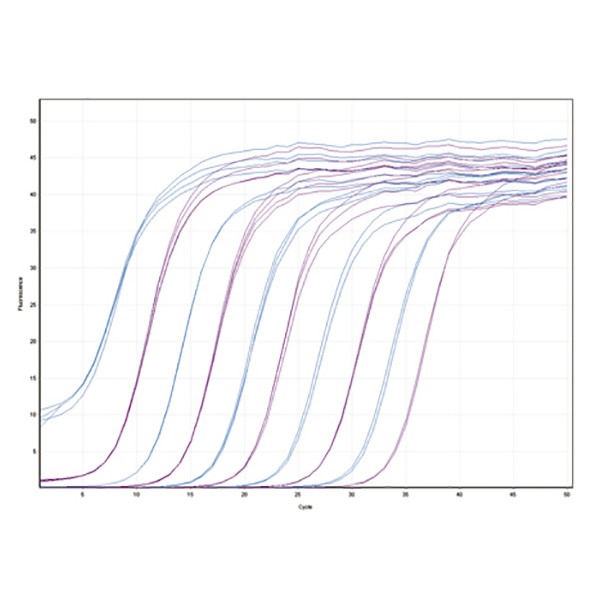
Broad dynamic range SensiMix SYBR Hi-ROX Kit

Amplification curves were obtained for the GAPDH gene over 10 log dilution series of plasmid DNA down to 50 copies. Reactions were in quadruplicate, using standard reaction conditions. The results demonstrate that the kit offers outstanding reproducibility and discrimination even across samples of low copy number templates.

Reduced primer dimer using the SensiMix SYBR Hi-ROX Kit

Melt curve analysis were obtained for GAPDH gene over 10 log dilution series of plasmid DNA down to 50 copies. The presence of one peak indicates that the fluorescence is not attributable to primer-dimers, even in the presence of low template concentrations of template, demonstrating that the kit consistently provides high specificity.

Product Description

The SensiMix™ SYBR® Hi-ROX Kit has been developed for highly accurate real-time PCR and has been validated on real-time PCR platforms that require high concentrations of the passive reference dye ROX for normalization of well-to-well differences.

A proprietary, highly-optimized, chemical hot-start PCR enzyme promotes highly-specific amplification, in turn improving assay sensitivity and dynamic range, ensuring that SensiMix SYBR® Hi-ROX Kit provide the sensitivity and specificity required for demanding assays under standard thermal cycling conditions.

The SensiMix SYBR® Hi-ROX Kit has been optimized to deliver optimal performance in tandem with the SensiFAST cDNA Synthesis Kit, which offers fast, unbiased cDNA synthesis, without compromising cDNA yield or coverage.

Applications

  • Gene expression analysis
  • DNA / cDNA target detection
  • miRNA profiling / quantification
  • Copy number variation (CNV) analysis

Product Specification

Concentration 2x
Presentation QT605-05: 500 x 50 µL Reactions: 10 x 1.25 mL
Appearance Clear, colorless solution
Hot Start Chemical mediated
Application SYBR-based, qPCR, two-step RT-qPCR
Sample type cDNA, DNA
Presentation 10 vials
Storage -20 °C, avoid exposure of the SYBR™ and ROX™ to light
Mix stability See outer label
Consistency ±0.5 Ct variance between test and reference sample
DNA Contamination None detected in PCR amplification with traces overlay with the negative control on E. coli and mouse genomic DNA specific targets.
DNase Contamination No detectable degradation

Product Ordering

Cat. No.              Size

QT605-05           500 Reactions

Product Support Material

View all Documents

What was a problem before now works perfectly! I tried several SYBR Green Kits but SensiMi...

Justus-Liebig University Giessen, Germany

FAQs:

SensiMix SYBR® Hi-ROX Kit

Why do certain kits contain a ROX?
The emission recorded from ROX during the baseline cycles is used to normalize the emission recorded from the reporter (SYBR®) in later cycles in some instruments. ROX compensates for small fluorescent fluctuations such as bubbles and well-to-well variations that may occur.
Why are the ROX concentrations different?
The amount of the ROX passive reference dye needed varies depending on the instrument optics. Our SensiFAST kits have been optimized for all these different instruments (see Product Selection Tool).
What is the difference between using ROX and using fluorescein?
Fluorescein is an alternative passive reference dye used just in the Bio-Rad instruments (see Product Selection Tool), the SensiMix SYBR® & Fluorescein contains fluorescein premixed in the mastermix at optimized concentrations.
Is the SYBR in a separate tube?
For your convenience the SensiMix kits have an optimized amount of SYBR® Green in the mastermix.
What could be done to avoid unspecific products in melting curve analysis?
Multiple products in melting curve analysis may be caused by unspecific products or primer dimer. However, appearance of multiple bands in melting curve analysis does not necessarily show different products. Multiple peaks may also appear, if distinct regions of the PCR product melt at different temperatures (e.g. due to an inconsistent GC content). We recommend to analyze the PCR product on a gel, to decide if unspecific products are present. The troubleshooting guide of your product insert includes several suggestions to solve these problems. In many cases problems with non-specific products can be solved if the annealing temperature is increased and/or the elongation time is decreased. If you have further questions, please contact Meridian Technical Support.
What is the advantage of working with SYBR Green I?
SYBR® Green I is an inexpensive, universal dye which binds to all dsDNA. It can be easily used in combination with a simple primer pair to detect PCR products in real-time. This dye is very attractive for researchers analysing lots of different genes.
What is the advantage of working with a probe system?
The probe system is always specific, probes only detect the gene of interest. It is also possible to distinguish between similar sequences with small differences like SNPs or mutations. In general, probe assays need less optimization than SYBR® Green I assays.
Can I use a SensiMix SYBR Kit for a probe assay?
This is not possible because the SYBR is pre-mixed into the SensiMix SYBR® mastermix.
Why do the SensiMix kits contain a hot-start Taq polymerase
Yes, polymerase activity during the reaction set-up causes non-specific amplification including primer-dimer formation. To avoid non-specific amplification the polymerase SensiMix contains a chemical hot-start that is only activated after heating at 95°C for 10 minutes, making SensiMix very stable at room temperature..
Why do you not sell kits contain dUTP (and UNG)?
This method is only effective if all the researchers in the laboratory, or using the thermocycler, are all using a dUTP/dNTP and UNG system. If even one researcher is not, it ceases to be an effective control. Using dUTP has also been shown to be inefficient as it increases the Ct values by reducing reaction efficiency. Most labs do not need to use the dUTP method of control, optimised protocols will allow high specificity of PCR and good lab practices (using disposable consumables, the use of filter tips and maintaining a separate area for PCR set-up and PCR amplification and any post-PCR analysis) virtually eliminate the risk of cross contamination.
What is the difference between a one-step and a two-step real-time PCR reaction?
In a one-step reaction the reverse transcription reaction and the real-time PCR reaction are done in one tube, making this a closed tube assay, so contamination can be avoided. It saves pipetting steps and time and is easy in handling, making it ideal for high throughput screening. In a two-step reaction the reverse transcription reaction and the real-time PCR reaction are done in separate tubes. It gives a more flexible way of working in that the cDNA can be used for more than one real-time PCR reaction and can be archived, eliminating the need to continually isolate RNA. For convenience Meridian sells the SensiFAST cDNA Synthesis Kit separately if you wish to take a two-step approach.
I would like to compare SensiMix with my current qPCR mix. What do I have to consider?
When comparing SensiMix with a mix from another supplier we strongly recommend to use the suggested conditions for PCR setup and cycling. Every real-time mix has its specific composition and different properties. That’s why they should be tested with their specific conditions, mostly this is possible on different plates only. We recommend amplifying from a ten-fold template dilution series. Loss of detection at low template concentration is the only direct measurement of sensitivity. An early Ct value is not an indication of good sensitivity, but rather an indication of speed.
What could be the reason of strange shaped qPCR curves? I observed an early increase of the signal and strange shaped qPCR curves without an initial plateau.
A possible reason is that the template amount is too concentrated. An early Ct may impair the baseline correction and may cause these strange curves. We suggest to dilute the template. Alternatively if the curve is flattened, this may be due to inhibitors in the reaction. Running a serial dilution of your sample will dilute the inhibitor concentration, if this corrects the problem, you will either need to go back and re-purify your template, or use it at a lower concentration, where the inhibitor effect has been diluted out.

Get In Touch With A Specialist

Have questions about a product? Want to learn more about Meridian’s molecular or immunoassay reagent portfolio? We want to hear from you!

By submitting your information in this form, you agree that your personal information may be stored and processed in any country where we have facilities or service providers, and by using our “Contact Us” page you agree to the transfer of information to countries outside of your country of residence, including to the United States, which may provide for different data protection rules than in your country. The information you submit will be governed by our Privacy Statement.